
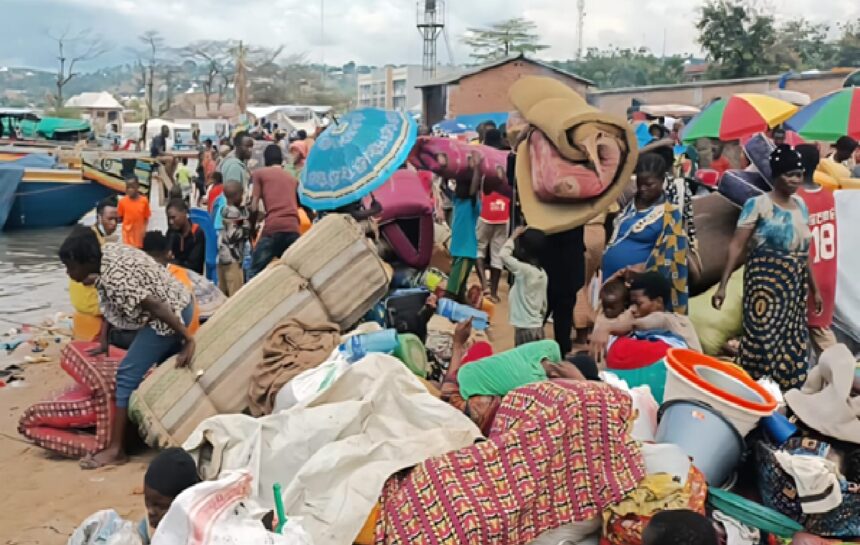
In Burunga province (southern Burundi), local authorities of Rumonge – a port city on the shores of Lake Tanganyika – have recently banned Congolese refugees from renting houses outside the emergency reception site opened in Mutambara. Brandished as a security measure, the decision has raised a lot of speculations.
Congolese refugees were temporarily settled on Mutambara hill or hosted by local residents until public power prohibited them from moving into private housing outside the emergency reception center, which itself lacks any basic infrastructure.
While expressing their gratitude to the government in Gitega, both refugees and Burundian citizens acting in solidarity strongly contest the position taken by Rumonge’s municipal authorities, whom they accuse of ignoring the unsanitary conditions prevailing at the temporary hosting site. « It is astonishing that even those among us who managed to flee Luvungi, Uvira, and Baraka with their savings are not allowed to enter into a rental contract so as to live with our families in somewhat decent conditions», laments Antoine K., a young trader from Baraka.
Security and Public Health Concerns
The disputed decision was taken on Friday, December 12, during a security meeting chaired by Augustin Minani, the Rumonge local administrator. He justified it by his administration’s responsibility to ensure security and public hygiene within the municipality, linking the measure to heightened security requirements following the dramatic destabilization that followed the fall of Uvira (population 700,000) into the hands of Rwandan troops and their auxiliaries from the AFC–M23. Rwandan military activism in South-Kivu has triggered a sudden influx of more than 3,000 Congolese refugees into Rumonge, most of them fleeing the city of Baraka in Fizi Territory since Thursday, December 11.
The municipal authorities justify the restriction by «the need to better control identity of those being hosted, in order to prevent the infiltration of hostile armed elements among the refugees. We call on the local population to remain vigilant in view of the threat posed by Rwanda’s belligerence».
Inhumane Living Conditions
On the refugees’ side, despair and distress dominate. Many denounce extremely precarious living conditions in Mutambara. «We are forbidden from renting houses, yet here in the camp where we are confined, we are forced to sleep outdoors. There are no latrines, no access to drinking water. Several young children are already falling ill. Many suffer from respiratory diseases because they have nothing to protect themselves from the cold, especially during freezing nights», testifies one refugee.
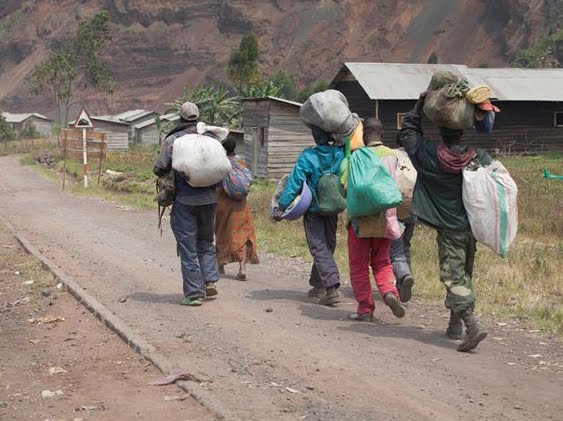
Rumonge is not an isolated case. In Bujumbura province, in western Burundi bordering Uvira, the communal administrator of Mugere, Adélaïde Hatangayo, has taken a similar decision, banning Congolese refugees from renting houses or being hosted by Burundian families even when family ties exist between refugees from border areas in Congo and their Burundian neighbors.
These decisions come at a time when the number of people fleeing atrocities in the DRC is increasing exponentially. Last Friday, Burundi’s National Office for the Protection of Refugees and Stateless Persons (ONPRA) reported that more than 30,000 Congolese were recorded in one week, adding to some 180,000 who had previously sought refuge to escape persecution carried out by the Rwandan expeditionary force and the Congolese renegades supporting it to settle particular scores.
These figures could soon double, as large numbers of Congolese continue to cross the border through unofficial entry points where Burundian authorities have no agents deployed. Smuggling and criminal networks are reportedly facilitating these crossings. Prior to this latest influx, Burundi had appealed in vain for international solidarity and emergency assistance for the refugees.
Intimidation strategy
The mass exodus of Congolese civilians to Burundi resulting from the Rwanda’s war of aggression is only worsening the already catastrophic security and humanitarian situation in eastern Democratic Republic of the Congo. The city of Uvira, which fell to the M23 during the night of December 9–10, lies just 20 kilometers from Bujumbura, Burundi’s economic capital, where the central administration and the main UN agencies are based. For nearly three decades, the Congolese provinces of North-Kivu and South-Kivu have been targeted by snipers and indiscriminate shelling by the Rwanda Defense Forces (RDF), whose 6,000 to 7,000 troops paradoxically intensified their offensives the very day of the validation of the Washington peace agreement by presidents Félix Tshisekedi and Paul Kagame, under the mediation of US president Donald Trump.
Reactivated in 2021, the M23 – a movement largely composed of Congolese Tutsis -has sought to forcibly establish a Tutsi buffer zone in the Congolese Kivu provinces by terrorizing and displacing members of other ethnic communities (Shi, Fuliro, Bembe, Rega, Hutu, etc.) living in the region. The attackers have also taken advantage of the situation to seize vast mineral resources, which are then sold by the Rwandan government to Western end users under the label of “Rwandan minerals.” Kinshasa vehemently denounces the ethnic cleansing and predation initiated by president Kagame himself. Maliciously, Kigali shifts narratives justifying its invasion alternately as “defensive measures” against the genocidal FDLR falsely depicted as an existential threat to Rwanda 31 years after their crime, and as a “duty of solidarity” toward the Banyamulenge (CongoleseTutsi from the Itombwe highlands), whom Kagame claims are victims of discrimination and persecution (sic) thus casting himself in the role of righter wrongs in Africa.
Regionalization of the War
Burundi, for its part, has deployed several thousand troops to the DRC by invitation of Kinshasa since 2023 in support of the FARDC and their allies, the Wazalendo patriotic peasant militias, which organized themselves to protect their communities from Rwandan abuses. Amid rising regional tensions, an agreement was signed in Washington on December 4 under US president mediation between the DRC and Rwanda. Burundi was represented as an observer by its president, Évariste Ndayishimiye. The agreement notably provides for the disarmament of the FDLR (described by Congolese president Félix Tshisekedi as “a residual force reduced to banditry”) as well as measures aimed at reducing tensions in the region.
Alongside the massive arrival of civilians, Burundi is also continuing to receive defeated combatants. Congolese soldiers, as well as Wazalendo militiamen, have crossed the border in recent days. On Saturday, December 13, at least 700 of them were welcomed in Rumonge, according to local sources.
Caught between security imperatives, mounting humanitarian pressure, and the direct repercussions of an increasingly volatile regional conflict, Burundian authorities now face a major challenge, as their reception capacity appears to be largely overstretched.
LMO, Le Maximum