
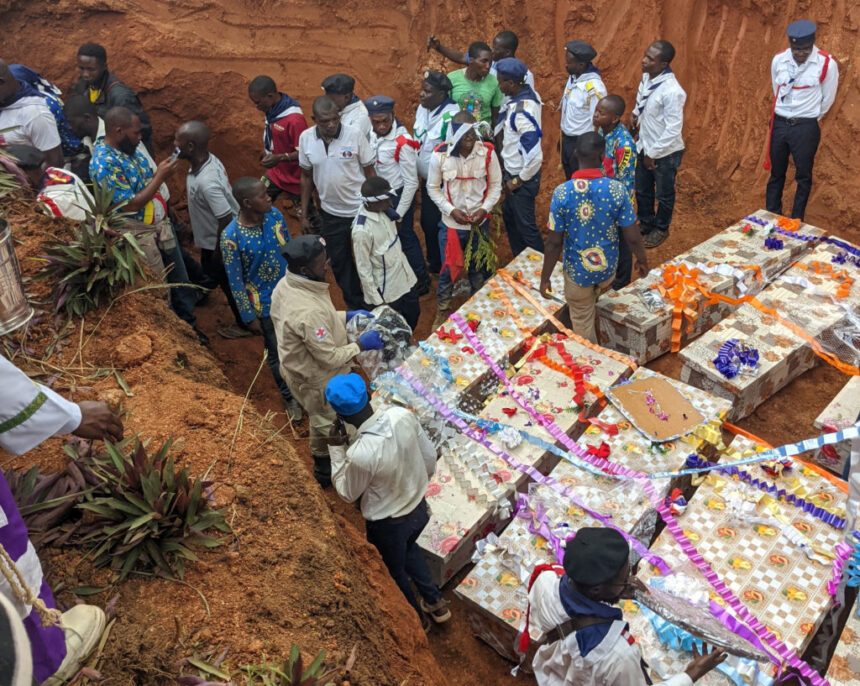
During the night of July 26 to 27, 2025, the town of Komanda in Ituri, DRC, experienced absolute horror. Jihadists from the Ugandan ADF rebels brutally slaughtered 43 people with bladed weapons. Among the victims were several members of the “Catholic Church Crusade” attending a prayer vigil at the Blessed Anuarite parish. In this town of Irumu territory,the attackers also set fire to vehicles and homes, took hostages, and then fled.
In Komanda, additional bodies of ADF victims were found in the rubble of looted and torched businesses. The dead included 19 women, 15 men, and 9 children. According to the parish priest of Blessed Anuarite, the assailants forced many other children aged 10 to 15 to follow them.
Local sources informed our editorial staff that the attack were launched from the ADF stronghold of Mount Hoyo, 12 kilometers away via Bogi road. The terrorists arrived in Komanda around 9 p.m. local time. The provincial military authorities claimed they were only alerted six hours later, around 2 a.m. “Concerned witnesses plot by thick smoke rising from burning homes and shops raised the alarm,” said an official.
The Komanda attack came as a surprise, following a long period of calm in this part of Ituri province, which had allowed many displaced people to return home.
A few hours after the carnage, the terrorists released a kidnapped woman, who returned to Komanda with a message for the local authorities: a demand to stop the joint FARDC-UPDF military operations against the ADF.
24 Victims Buried on Monday
On Monday, July 28, 2025, Komanda held a burial ceremony for the victims in a large mass grave. Twenty-four bodies were displayed for a final tribute before burial in the Catholic parish compound. Funeral expenses were covered by the DRC central and provincial governments, according to a statement issued by the Prime Minister Judith Suminwa. She declared: “In the face of such atrocity aimed at spreading fear, the authorities reaffirm their commitment to protecting civilians, supporting grieving families, and eradicating terrorist activity in the region”.
Later on, the Komanda massacre was formally claimed by the Islamic State group (Daesh) on a newspaper article in its Telegram channel of Tuesday, July 29, 2025, according to Reuters.
Since Sunday, the FARDC and UPDF have tightened security measures around the martyr city. “The army will remain here to hunt down the enemy until complete security is restored. If they think FARDC will withdraw, they are wrong. On the contrary, more troops are being deployed to keep you safe, day and night. Measures are also being taken to secure other localities,” said Major-General Bruno Mandevu, operational sector commander in Ituri. He also urged the people of Komanda to refrain from any collaboration with the ADF. “The enemy entered because some of our own children from Komanda helped them. Stop collaborating with the ADF immediately,” he insisted.
Military reinforcements
MONUSCO, for its part, announced additional patrols around Komanda, a town located about 60 kilometers from Bunia, the provincial capital of Ituri.
Two days after the massacre at Blessed Anuarite parish, life seemed to be slowly returning to Komanda. Encouraged by the local branch of the Federation of Congolese Enterprises (FEC), economic activities are cautiously resuming. “Security is now assured. Do not be afraid. Security forces are mobilized to protect the population and their property,” said Eric Vuruga, a local leader of the employers’ organization, as quoted by ACP.
The shockwave caused by the atrocities in Komanda quickly spread beyond the DRC’s borders.
On Monday, July 28, Pope Leo XIV expressed his “dismay” in a telegram published by the Holy See. “His Holiness Pope Leo XIV has learned with dismay and deep sorrow of the attack on Blessed Anuarite Parish in Komanda, Ituri Province, which caused the deaths of several worshipers gathered for prayer,” reads the message, signed by Cardinal Pietro Parolin. “This tragedy calls us to further work toward the integral human development of the afflicted people of this region,” the Pope stated.
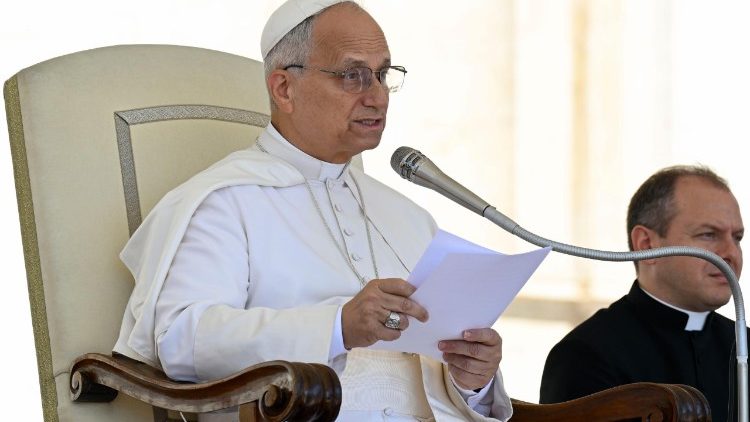
In the telegram addressed to Archbishop Fulgence Muteba, President of the National Episcopal Conference of Congo (CENCO), the Pope “implores God that the blood of these martyrs be a seed of peace, reconciliation, brotherhood, and love for the Congolese people,” and “sends his apostolic blessing to the parish of Blessed Anuarite in Komanda, especially to the grieving families, as well as to the daughters and sons of the Democratic Republic of Congo and the entire nation.”
The Vatican’s Concern over the Attack on the Church
Beyond this message of comfort and compassion, the Vatican is pointing out the implications of this attack. The Secretary of State of the Holy See sees it as a “worrying signal” for Christians. “After ethnic, cultural, or socio-political conflicts, this religiously motivated attack against the church in Komanda worsens the crisis in Eastern DRC,” said Cardinal Pietro Parolin, quoted by Vatican News on July 28, 2025.
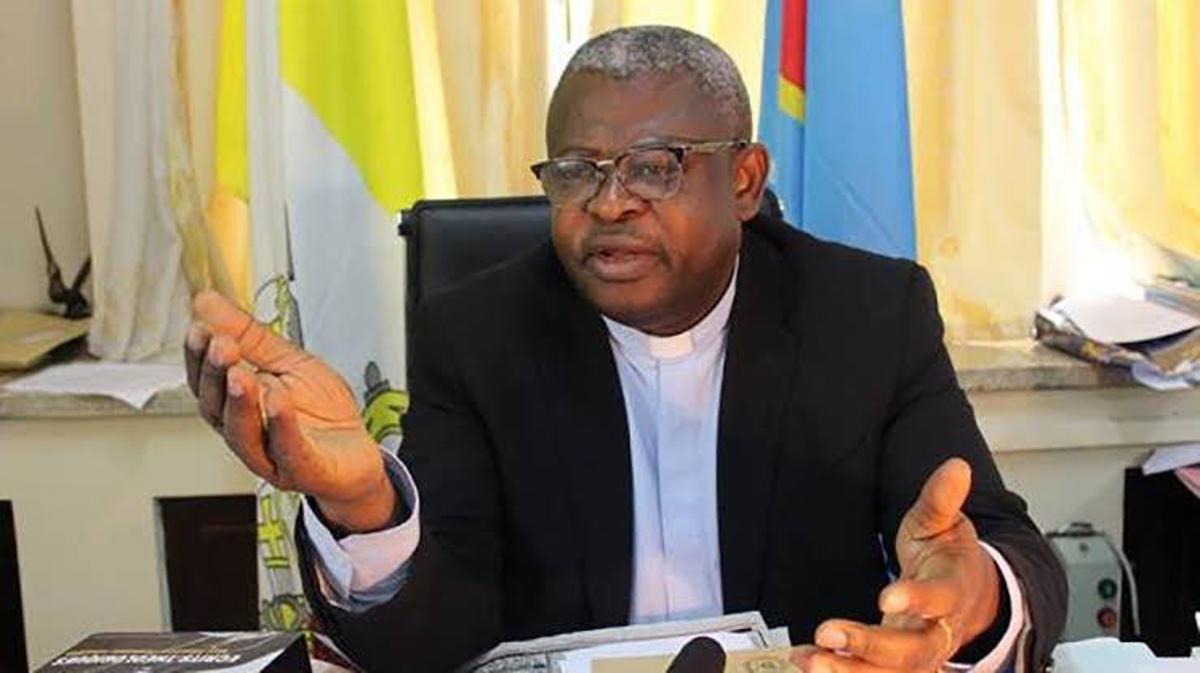
Unlike the Vatican’s position, which brings to light the dangers and consequences of this bloody assault on Congolese religious life, some catholic leaders within the CENCO remains stuck in their usual political speculations. In an interview with RFI, Monsignor Donatien Nshole, Spokesperson of the Congolese Episcopal Conference, depicted the Komanda tragedy only as an opportunity to advocate for the controversial Social Pact to Restore Peace in the DRC and the Great Lakes region. “This situation is beyond us. At the same time, it reveals the complexity of the security situation in this part of the country. Unfortunately, these are not issues considered in the Washington or Doha agreements,” he stated, referring to the agreements between the DRC, Rwanda, and the M23 rebels brokered by the US and Qatar. “This is why we are truly exasperated,” he added. “We insist on implementing the social pact initiative so that, with the help of our experts, we can also delve into this case. The government must first take responsibility for securing the population. And we expect a serious investigation to identify the attackers and understand their demands,” Nshole emphasized, despite Daesh’s claim of responsibility. “It is regrettable that the Catholic Church hierarchy in the DRC prioritizes its proximity to a certain political opposition over the jihadists’ zeal to forcibly convert Congolese Christians to Islam,” protested Justin Mwetaminwa in an analysis published by the French Institute of International Relations (IFRI) last May.
CENCO Preaches for Its Own Parish
This somewhat irresponsible stance by the Catholic Church leaders in the DRC is further reflected in their accusation that the government is “incapable of identifying the Komanda attackers.” “Some say ADF Islamists, others ADF/MTN ISCAP? Do these serial killers have a list of demands?” the prelates pondered, while wondering “who benefits from the crimes committed for years against peaceful citizens.” The conclusion is clear: “Faced with yet another violation of human dignity by attackers only identified as ADF Islamists—a terrorist association part of the nebulous network of armed groups operating in the eastern part of our country—we insist on implementing the joint CENCO-ECC initiative for a social pact that could also address this situation,” reads a statement signed by Archbishop Fulgence Muteba, reducing the Islamist terrorists to a mere local armed group.
Solidarity from American Pastors
Catholics are not the only ones shaken by the horror in Komanda. Pastor Mark Walker, itinerant ambassador for international religious freedom recently appointed by Donald Trump (pending Senate confirmation), expressed his outrage on his X account on Tuesday, July 29. “Once confirmed as ambassador, I look forward to denouncing these hellish infidels. Until then, I will pray for the families of the victims and for President Tshisekedi to eradicate this scourge from the DRC,” he wrote. “May God bless the DRC, President Félix-Antoine Tshisekedi, and the Congolese people,” added his colleague and fellow American, Travis Johnson. “You will pray alongside a growing number of global leaders, nations, and institutions standing with the DRC for peace, prosperity, and the strength of its people and nation,” he continued.
Reverends Mark Walker and Travis Johnson are part of the White House Faith Office, a delegation of which was recently received by President Tshisekedi during a visit to the DRC. They are known for their strong advocacy for the DRC and its legal institutions, widely echoed in Christian and political circles in the United States.
Jacques Ntshula and Le Maximum